

In what is now a tradition for more than a decade, my company’s new year trip has took an interesting turn after a few of us were yet again denied of Korean visa. Oh no, the K-pop fans in us were sad once more! And we already had a departing ticket to Seoul. But should we go to Jeju again? It’s beautiful, and there are more parts to explore. However, we should arrive to Jeju without transiting from other parts of Korea. Thus, the ticket would have to be cancelled. Which country could we transit from Korea then? Mongolia? That’s my dream – but our travel date is too short. Kyrgyzstan for the different -stans? Too far, makes our schedule even shorter.
So… time to decide on which country to go to. Any of the visa-free countries, that is not southeast Asia. And there it is, a country kinda far, yet small enough to feel like we can maximize a few days of stay. Nepal.
It takes 3+ hr from Manila to Bangkok, and another 3+ hr from Bangkok to Kathmandu. In our case, through Thai Airways, we had about 2 hr layover in between. That practically ate up our January 1. Given that we had to be back by January 5 to the Philippines, we only had 2 full days to make the most of Nepal. So be it.
We each filled up a visa on-arrival application form before the trip. We were not able to pay through their online portal however, so we just had to settle upon arrival. The form is also available at the airport, but pre-filling would make your transaction faster.
Upon landing on Kathmandu, I already sensed that the country is still developing: small international airport and a less organized flow when you step outside of the arrival hall. And with the winding roads and cool weather, it’s like landing on a city like Baguio (Philippines) or Jiufen (Taiwan). But that’s only for a brief moment. The uniqueness of Kathmandu was apparent. The Newari scripts on buildings, the dry air, the smell, dust, the narrower streets and the people. Although some Filipinos can blend in with Nepalis.
A soft-spoken driver picked us up. When he drove, that’s when another indicator of the developing country was revealed. There weren’t much traffic lights and the vehicles get pretty close to each other, while most drivers are unbothered. Soon after leaving the airport area, the roads narrowed. Some look like one-way streets, but nope, they’re two-way use, that are too small for my comfort! Interesting… exciting!

We were booked at Ramada Encore. They have a rooftop restaurant and bar, where we headed up as a couple of us needed to eat. With no plan to eat anything, I of course approached the bar after seeing the beer tap. There were two varieties of Barahsinghe, a local craft beer, available. I chose the hazy IPA and uhmm, it’s pretty good.
Visualizer on YouTube:
January 2
In the morning, I started breakfast minutes before the hot food were served at the hotel. Nepal is behind by an odd 2 hours and 15 minutes from the Philippines. So in spite of our late arrival, I woke up early for their time. I did get a few items when the hot food were available, but I wasn’t able to appreciate the food just yet.
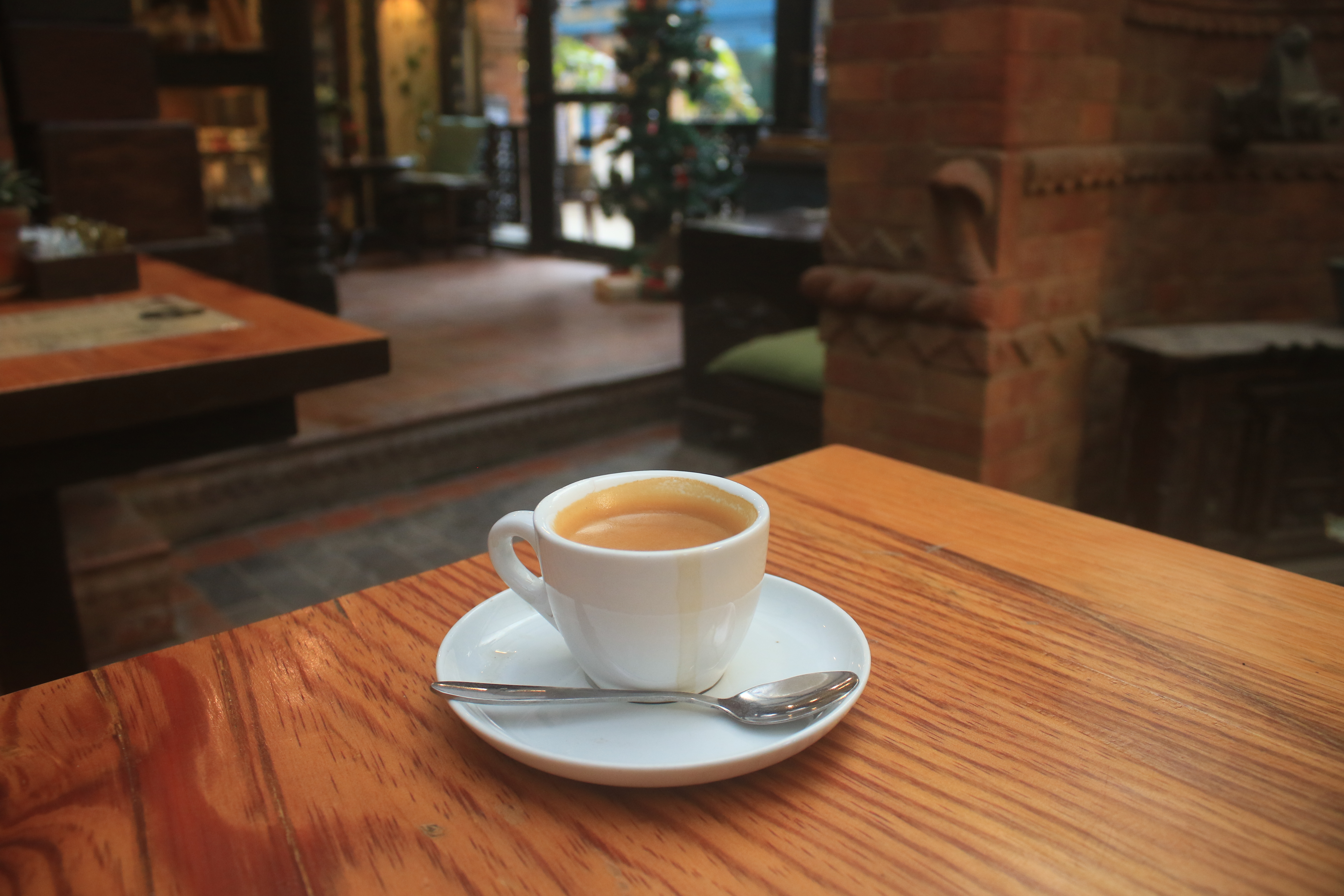
I already noted a few of the nearby coffee shops prior to departure. So, I walked to one while my family and colleagues were not yet at the ground floor. I found the cafe inside a guest house, with classic Kathmandu architecture (I suppose): Coffee Ghar. Shortly after, the rest of our pack got to the coffee shop, and sure enough, we all took photos in the property. Then, it’s time to take the tour care of Himalayan Windows Tours.
Greeting us was Anish, a Kathmandu native (Newar) who looked so much like one friend of mine, as if he’s a long lost brother. I had to take a photo with him to show the group chat with that friend, just for laughs!
Patan Durbar Square in Lalitpur was our first stop. It is filled with classic buildings: palace were monarchs used to live, and temples for worship. These buildings are worthy of pride for the Nepalis, as they are works of art. There are so many intricacies on every surface. That’s what a lot of time without distracting devices can do!
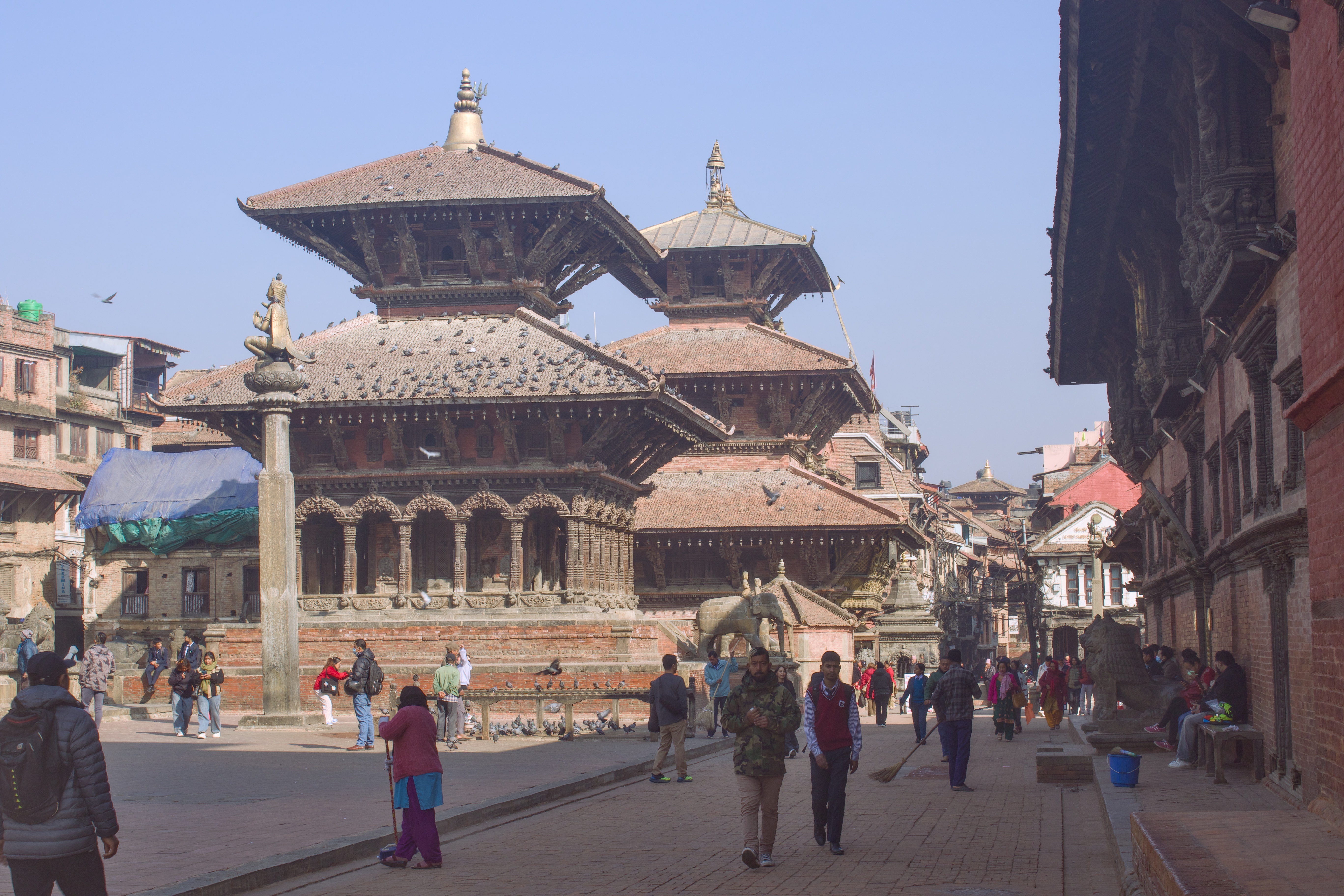
Many of the unique architecture are influenced by the religious beliefs of the land. In the case of Patan Durbar Square, it is a mix of Buddhism and Hinduism. And the details whether just patterns or images, are impressive. If you think about our modern world, such attention to details are very rare in architecture. So to me, it evokes a respect for the efforts and brilliance of past peoples. In the case of Buddhist influence, the Buddha image and animals abound; for Hinduism, images of gods, including animals as well, were prevalent. It is also noticeable, and the guide would always caution us, how the intricate doors leading to halls and the courtyards are small, alluding to the general height of the natives.

Outside of the square, we were brought to the Tibetan Singing Bowl and Healing Center. This is owned by probably the longest line of family making Singing Bowls in Kathmandu. This was a highlight for us, because of the sensory and spiritual experience.
A short baby-faced man in his senior years runs the said shop. He led us to the basement where he conducts the demonstrations. Singing bowls basically are resonating metal bowls typically made of brass or bronze. It produces a resonating sound when tapped or when you slide a mallet or stick at a specific pressure round and round the brim. That makes a singing bowl a good accompaniment to meditation. And boy, was that sound soothing!

There are different sizes of singing bowls. The small ones can only be used for meditation. While the bigger ones can be used for healing. One basically initiates the resonating sound as the bowl is placed on different areas of the body. The sound I heard for the first time was music to my ears. It’s so captivating and it’s lingering resonance relaxes.
One demonstration, illustrated the sound waves and vibration by sliding the mallet around the brim of a big singing bowl filled with water. It’s a physics example. Our guide alluded to how the vibrations can affect our body, being mostly filled with water, in a similar way. I’m not gonna make any more connections or infer, but basically the sound of the singing bowl is believed to have the ability to heal. The healing was demonstrated to us through my cousin and niece. And then, we were all made to stand on the very big bowls. So, we all experienced being enveloped with the relaxing sound and vibration. It felt really isolating, in a good way. The vibration made me feel like pooping for a bit, if I’m being honest. But it’s an overall good experience.
We all got singing bowls. I got a small, full moon singing bowl, that sounds incredible. Such singing bowls are made only during full moon, and should be completed while that phase of the moon lasts. It has less intricacies on the surface due to the limited time. They are believed to harness the energy of the full moon during production, so they are more special compared to the other bowls.
Singing bowls can also be filled with water, and you can put orange and red flowers on it. Such set up is believed to absorb negative energy. A lot of places in Nepal have these bowls filled with orange and red flowers. So we understood why, and noted that use for the singing bowl.
We then headed for lunch at the upper floor of the same building as the Tibetan Singing Bowl and Healing Center. And that’s when I had a taste of the good cuisine of Nepal. Momo (dumpling) seems to be all over the area, so I tried it. I chose the water buffalo Momo, and paired that with mixed fruit lassi. And wow, the Momo is so savory and filling, and the mixed fruit lassi, which is basically a fruit yoghurt smoothie, is good to pair with that flavorful dish.
Throughout the day, we took our time, some buying souvenirs along the way.
We entered an old monastery before leaving Patan: Hiranyavarna Mahāvihāra/Kwa Baha. It is sometimes called the golden temple, and a few parts of the monastery are indeed gold plated. This is where I saw a large prayer wheel for the first time. While this is a Buddhist temple, there are a few elements of Hinduism in the designs. Before leaving, we saw a group of kids that had the pleasure of meeting the monks assigned as priests of the temple, with whom they had a photo op.

Boudhanath Stupa was our next stop. That spherical stupa is the largest in Nepal and one of the largest in the world. Most noticeable to me are the eyes painted on top, as I have not encountered such in Buddhist monuments. These are representative Eyes of Buddha, that are all-seeing. Non-believers weren’t allowed to enter, if I remember correctly, so we were just around the base.
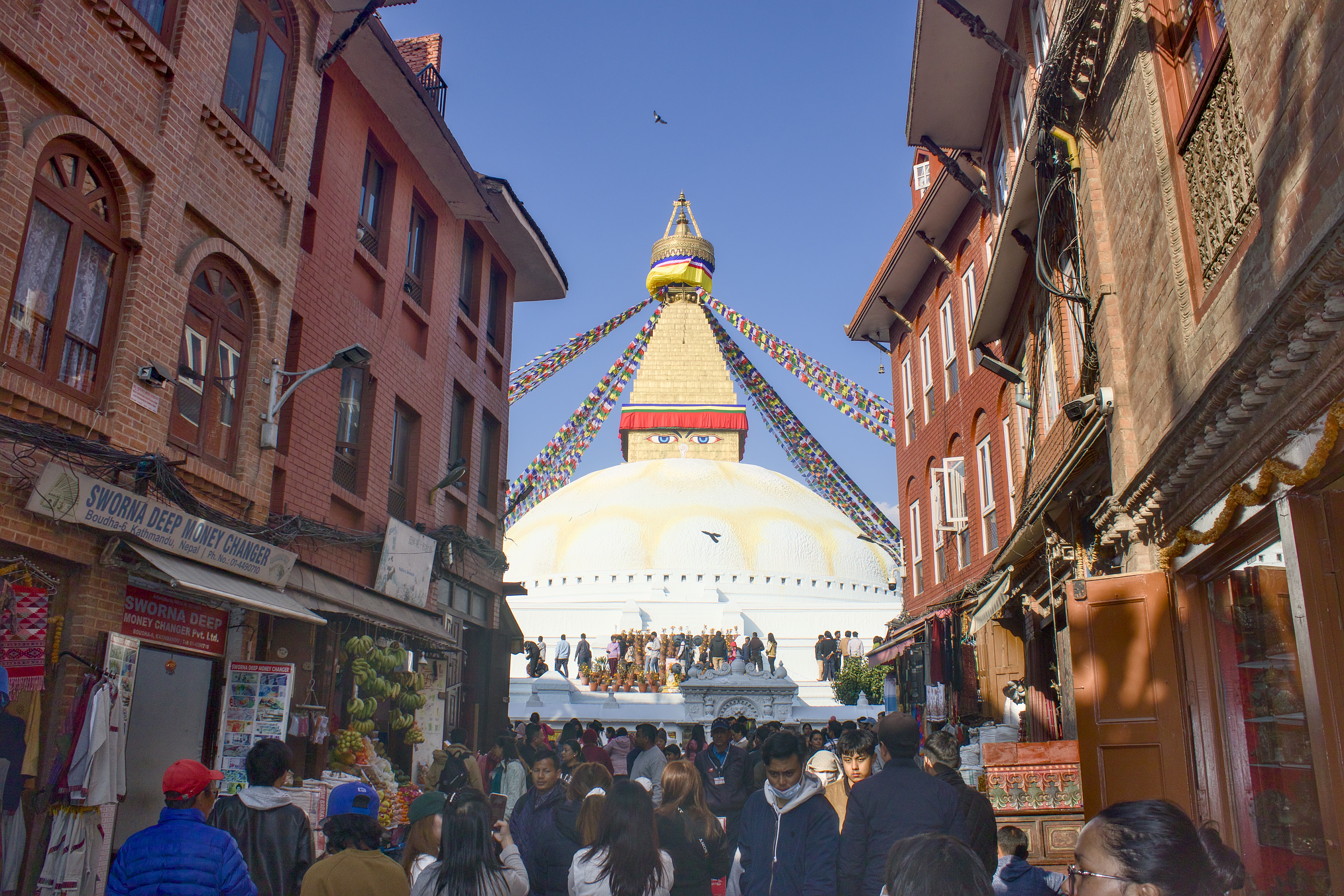
The stupa is surrounded by shops and obviously a touristy area. One can consider it a lively street with a majestic rotunda. In spite of that, you can feel the holiness of the site upon seeing different Buddhists doing their rounds, spinning the prayer wheels and reciting their prayers. I’m particularly struck by the Tibetans praying there; one’s just really made to behave around them.
During our free time, we spread between buying souvenirs and getting drinks. Some of us went to Himalayan Coffee shop, which is pretty nice, for they have a specialty coffee approach. I ordered a pour-over. I haven’t bought anything yet, and I saw on the shelves that there are also tea leaves available. I saw white tea… oh, I haven’t tasted that before. Later I learned that white and silver tip teas are available in the country, and are prized varieties. I’m yet to open the pack, but I’m planning to prepare it Taiwanese style. Then, I bought just a fridge magnet and key chain of the Nepal flag. We noticed that there are rarely any treats in Nepal, that are good for take home presents. I guess refined sugar is just not big part of their diet. Good for them if that’s the case.

As the sun is setting, we headed to Swayambhunath (Monkey Temple), and reached it at night. Due to the build up of traffic, we climbed up at the side with the high stairs. We were cautious of the monkeys that are all over the place. They’re pretty chaotic, competing for food, mate, whatever. You’ll just hear or see confrontations break out from time to time. The hill is also a place for fitness enthusiasts, you’ll see some people exercising, whether thru the stairs or at a spot where they do calisthenics or basic body weight workout. At the top, we get to see another stupa, with the all-seeing Buddha eyes. A mixture of faithfuls and tourists fill the area as usual. More monkeys hang out there, up to the roof of the stupa. And we got a nice view of the valley at night, under the crescent moon. We headed down through the other side that’s less steep, with less steps, as the van was waiting at the back gate parking lot.

Silent chaos, that’s an oxymoron I can use to describe Kathmandu, and maybe majority of Nepal cities. The people are generally quiet and soft-spoken, and not aggressive. That demeanor contrasts with the chaos of the vehicles on the streets, the colorful facades, the unordered wires running through the electric posts, and temple monkeys.
We topped the night with a nice dinner at the rooftop of our hotel. And I kept appreciating the food. We also could not help but tap our singing bowls at night. I can overhear the other parties on both sides of our room doing the same. Haha!
January 3
The next day, I waited for the breakfast buffet to fully open, so I can enjoy it. The food is surprisingly good in Nepal! Just the right amount of spice for my liking.
On this day, we focused on nature. Our first stop was Chandragiri Hills. The elevation of the hills are above 2500 meters. They’re already considered mountains in many parts of the world, such as in my country. But by Nepalese standards, they’re just hills.

The Himalayas are still far from there, so we hoped for a clear day. And it was – there’s enough clearance for us to be in awe of the majestic Himalayas from afar. Even before riding on the cable car, we could already see parts of the Himal. It was a thrill!
We rode the cable car to be closer to the top of the hill, revealing more parts of the mountain range. We hiked a little bit to reach the top, and along the way, there was a point to see Mt. Everest. It’s faint, and behind another mountain, but we’re lucky to still get a glimpse of it.

There’s a temple, a souvenir shop, restaurant with view, a few food stalls and cute rides at the top of the hill. And we just took our time appreciating the wonderful view. I realized our trip is really too short for a Nepal visit. We could at least go closer to the Himal.
We got on the cable cars again going down. But before we left, we had coffee and again, just took our time. This trip really put me in a peaceful and meditative state. Except for processing the view and experience, my mind was just mostly blank.

We headed for lunch in Lalitpur, at a restaurant with a nice ambiance: Be Perky Garden Boutique Restaurant. And once again, the food was delish. I ordered Paneer (fresh cheese) Tikka and Chicken Malai Tikka. And I was so satisfied with them! I paired the food with another Barasinghe Craft Beer – a pielsner this time. The only issue I had with the restaurant was that the food preparation was long. We had to wait almost an hour. The fries, probably not commonly ordered, took way too long.
Satisfied anyway, we then made another stop near Patan Durbar Square for a bit of shopping, before heading to our next nature destination: Nagarkot.

At Nagarkot, we stopped and hiked a little bit to go to a hanging bridge: Rani Jhula, if I’m not mistaken. We traversed the bridge both ways, with stops in between for some photos, of course. It was dizzying when I looked down, as the bridge is suspended quite high across the gorge. But again, I was in Nepal. That’s not quite high enough. This spot was where we stayed till sunset. So, by the time we reached the Himal viewing area at Nagarkot, it’s already nighttime. The point we’re supposed to enjoy views was Hotel Country Villa. Our guide however, directed the driver to stop about 1 km away, so we hiked to go to the hotel. It’s probably a customary tour arrangement in that spot. But there wasn’t much point to it, as it was already dark. It’s okay, exercise is good.
Hotel Country Villa is a huge hotel that offers stunning views, regardless of clearance. It has many spots to hang out for such. But I only imagined that scene in the dark. With no views, we just enjoyed dining outdoors, beside a heater, as the temperature has dropped uncomfortably cold. There were many choices in the menu, but I picked a Nepali dish once again. Yum!
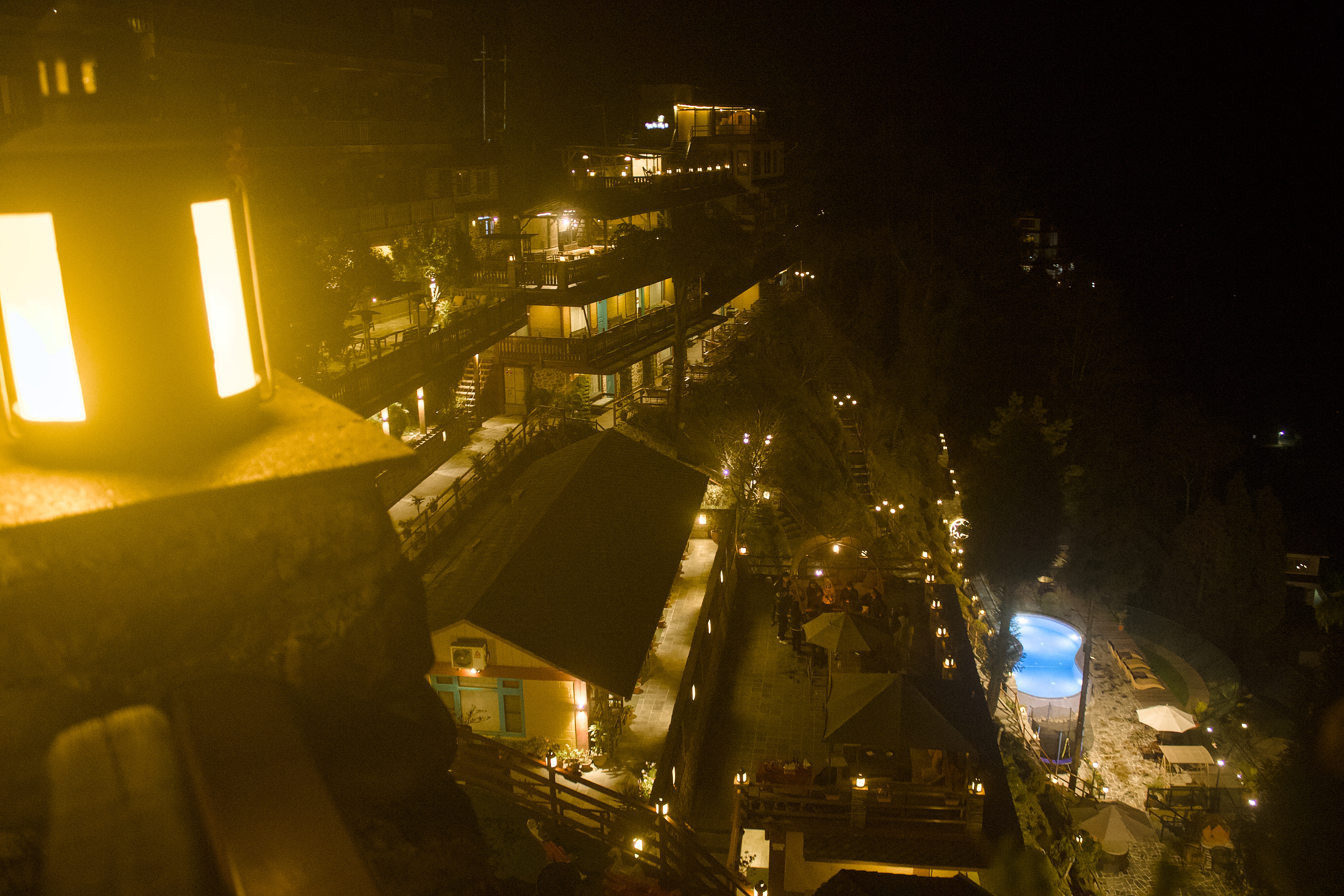
I realized I’ve been drinking daily since before New Year’s eve. So I stopped myself from getting beer, despite seeing another Barasinghe tap! Also, I liked the folk music playing in the background, courtesy of a duo performing live with local percussion and string instruments. It really fits the vibe.
We headed to Kathmandu and winded down. That’s the end of our tour, as we would travel back the next day.
January 4 & 5
After another filling breakfast, we dropped for coffee once more at Coffee Ghar, before leaving. That’s quite a short trip, Nepal, I’d like to see you again! And as we flew out of the country, the day was very clear, that we could see the Himalayas! Too bad, none of us were seated at the right window side!
Our flight back had a long layover. So, we packed in such a way that we had a set of clothes in our hand carry bags, to be able to change in Thailand. We decided to go past immigration of Thailand’s Suvarnabhumi International Airport, and explore a bit of Bangkok. We booked a hotel in Suvarnabhumi only upon arrival, before passing the immigration.
Getting around was easy for us because of the familiar Grab app. We went to 2 places: Mega Bangna – a nice, big mall that kinda reminds me of SM Mall of Asia, in the Bang Phli District of Samut Prakan (outside Bangkok). And then, we went to Train Night Market Srinagarindra in Bangkok – the nearest to the mall we stopped at. It was a fun night, just taking in the city vibes of Thailand at night.
I didn’t shop for anything, so when I heard a bar performer singing a heavily accented version of APT, I decided to stop there to get amused, and grabbed a bottle of Singha (beer again!). I just waited for my colleagues/family to be done with their shopping.
Early morning the next day, it’s time for another 3+ hr flight, this time for Manila. And that’s the end of our new year incentive trip. Most of the expenses really were due to the plane tickets. Next time, if we are to go back to Nepal, we’ll make sure it is not a fall-back destination and book earlier.
Checkout @jecoycoy on Instagram for the photo dump!


 The Journeying Engineer
Leave a comment